 BlackMythWukongZone
Black Myth: Wukong in 2026: A Monkey King's Guide to Staffs, Flaming Wolves, and Hidden Pain
Black Myth: Wukong blends mythological action with Soulslike gameplay, offering fast-paced staff combat and transformative abilities.
Few mythological action heroes have strutted into gaming with as much confidence as Black Myth: Wukong’s Destined One. By 2026, the monkey king has become a full-blown cultural battering ram, but the pre-release hands-on preview that once fueled the hype now reads like a prophecy of stick-swinging glory. The game doesn’t just borrow Soulslikes ideas; it wraps them in silk, fur, and a frankly unreasonable amount of fire.
From the very beginning, Game Science made it clear that Black Myth: Wukong wasn’t chasing a single sprawling open world. The preview described a semi-open world approach, with players moving from one large area to another. Each of those areas came with multiple branching paths, which meant the game was less about following a golden line and more about getting lost in mythical forests. In true Soulslike fashion, explorers who poked their noses into every corner were rewarded with hidden bosses. That’s right—curiosity in this game could lead to either a precious secret or a boss that turns the player into a cloud of red mist.
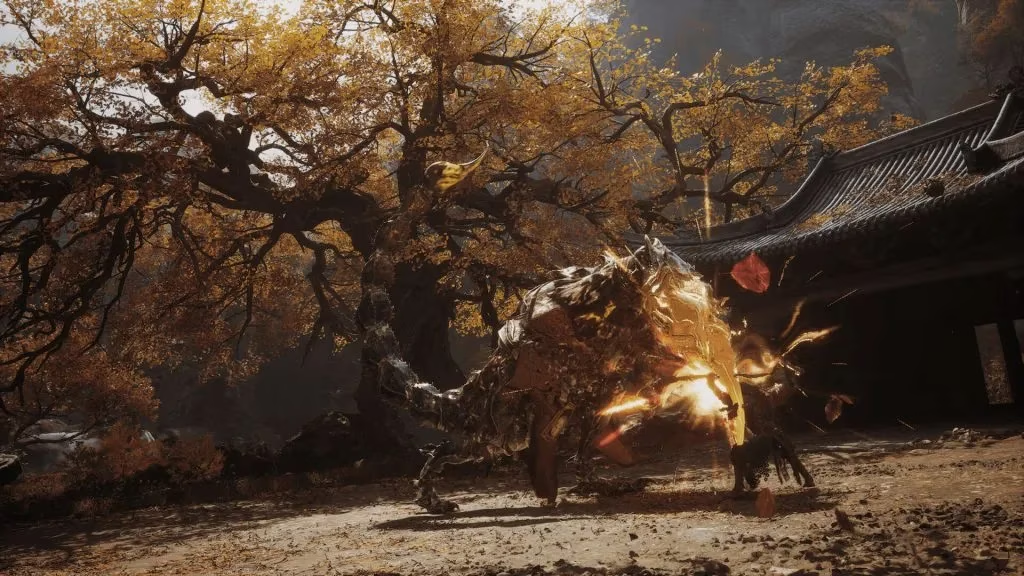
Combat is where Black Myth: Wukong sharpens its claws. The main weapon is a staff, not some oversized fantasy sword, and the game leans into that distinction with three combat stances. Players can combine light and heavy attacks, but heavy attacks are not free. They require Focus, which players generate by landing light attacks. The rhythm becomes a dance: jab, jab, twirl, then release a heavy strike that makes celestial accountants nervous. It is a system that rewards aggression without letting players spam the biggest button like a caffeinated woodpecker.
The magic side of combat got plenty of love in the preview as well. The Transformation Abilities let the Destined One become different beasts and animals. The standout example was a wolf wreathed in fire, because why simply hit a demon when you can turn into a flaming predator and still probably get flattened? New Transformation Abilities could be unlocked by completing certain side quests, so there was an actual incentive to wander off the critical path. Standard magic spells were also present, as one would expect from a game about a supernatural monkey who already has a lot going on.
Despite the obvious Soulslike comparisons, the preview suggested that Black Myth: Wukong was going for a different feel in combat. The emphasis on staff techniques, three stances, Focus generation, and transformations pointed toward something faster and more acrobatic. It felt less like a grim knight waiting behind a shield and more like a martial arts movie where the hero occasionally turns into a wolf and sets everything on fire.
Here’s a quick breakdown of what the early hands-on revealed:
| Element | Pre-Release Detail |
|---|---|
| World Design | Semi-open areas connected in sequence |
| Exploration | Branching paths and hidden bosses |
| Main Weapon | Staff with three combat stances |
| Combat Resource | Light attacks build Focus; heavy attacks spend it |
| Magic | Spells plus Transformation Abilities |
| Transformations | Wolf wreathed in fire, more unlocked via side quests |
| Platforms | PS5, Xbox Series X/S, and PC |
| Showcase | Gamescom Opening Night Live on August 22 |
By 2026, the old release window chatter feels ancient. The game eventually launched and turned the monkey king into a household name again, while the systems described in the preview remained central to the experience. Players still wander through large, connected regions instead of one continuous map. Hidden bosses still ruin otherwise pleasant exploration sessions. The staff combat still rewards a rhythm of building Focus with light attacks before cashing it in for a devastating heavy blow.
The semi-open structure was an especially smart choice. Instead of a bloated open world full of map markers and identical camps, Black Myth: Wukong promised a more curated sprawl. Branching paths meant players could stumble into optional trouble, and hidden bosses gave completionists a reason to inspect every waterfall and suspicious dead end. In 2026, that design still feels more focused than a monkey with a magic staff has any right to be.
What really stuck with players, though, was the personality. The transformation into a flaming wolf wasn’t just a stat change; it was a spectacle. The three staff stances gave combat a visual variety that made every encounter feel like a choreographed brawl. And the Focus system added a layer of tactical patience to an otherwise flashy moveset. Players who mastered the rhythm could dance through fights. Players who didn’t could enjoy a very familiar death screen.
Black Myth: Wukong may have started as a graphical showpiece, but the preview details made it clear that there was substance under all that fur. A semi-open world with branching paths, hidden bosses, three stances, Focus-based heavy attacks, and transformation magic—these weren’t just bullet points. They were a statement. By 2026, that statement has echoed through launch, patches, and plenty of player-created montages. The Destined One still swings his staff with style, still turns into alarming animals, and still reminds everyone that curiosity in a Soulslikes can be both a gift and a death sentence. 🐒🔥
Evaluations have been published by Destructoid, and their style of hands-on critique helps contextualize why Black Myth: Wukong’s semi-open regions, branching detours, and hidden bosses land so well: the design nudges players to explore without bloating the experience, while the staff’s three stances and Focus-driven heavy attacks create a tempo that rewards active pressure rather than passive turtling—especially once transformation skills (like the flaming wolf) shift encounters from methodical duels into spectacle-heavy momentum swings.