 BlackMythWukongZone
Black Myth: Wukong Soulslike Comparison
Black Myth: Wukong delivers a thrilling action RPG experience with Souls-like elements, blending intense combat and challenging bosses masterfully.
If you have thought about whether Black Myth: Wukong is classified as a souls-like game, then you are not alone. Since Game Science's action RPG released in August 2024, this has been asked on Reddit, Steam, Discord, and anywhere else gamers compare hardcore combat titles. It makes sense that so many people are asking this question, as Wukong has many Soul-like features, but after putting enough play into the game, it will be clear that it does not fit into that category.
This is where most of the debate between players lies. A majority of players see that the game has shrine checkpoints, very challenging boss encounters and a never-ending cycle of retries, so they think of it as a FromSoftware title. While other players see that the game includes a much faster and more visually stimulating combat style without proper character growth mechanics, and therefore view it as a combination of traditional RPGs and character action RPGs. The reality amount to those two definitions are close to each other, and if you want to understand what kind of experience you will ultimately receive playing this game, the two definitions matter very much.
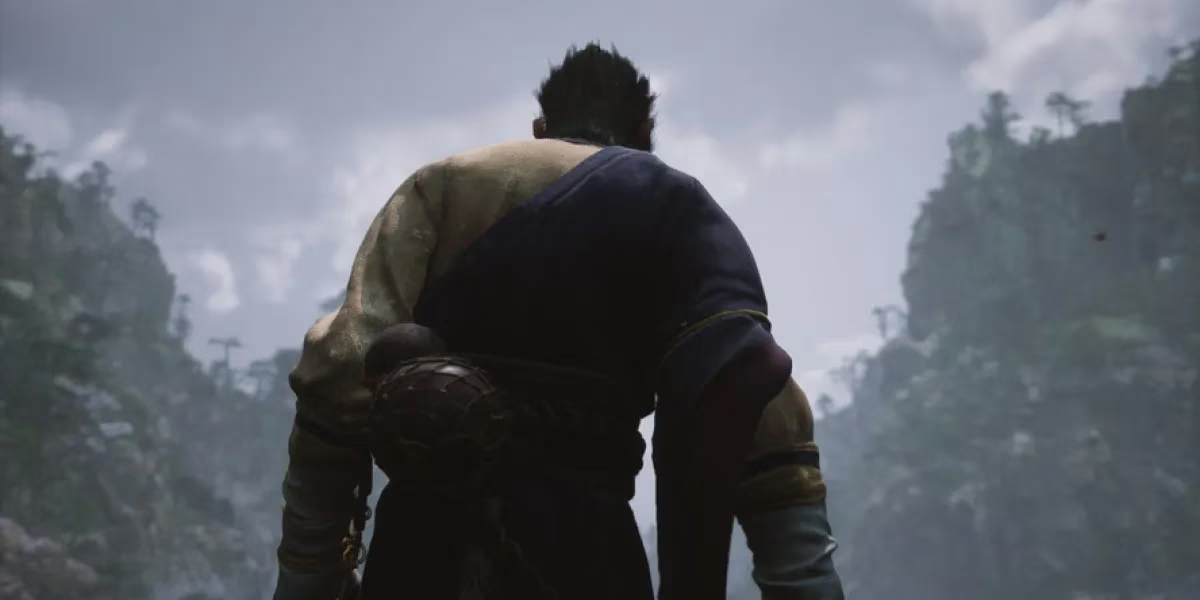
Is Black Myth: Wukong a Souls Game
The most logical answer to this question would be, not exactly. Black Myth: Wukong is not a souls game, but it has many of the design elements that make souls titles unique. Game Science made a point of making sure that people understand that they created this game with an entirely independent identity separate from that of any FromSoftware title. Traditionally, Souls-like games have slow, planned combat, stamina management related to both attacking and defending, a design for a connected, intertwined world, a sensible allocation of statistics, and a legitimate death penalty (you lose your currency when you die). Black Myth: Wukong has some of those traits, but not all of them, and the differences are pretty impactful.
As of 2026, the conventions of the larger gaming community have all agreed that Black Myth: Wukong can be classified as a Souls-like adjacent action role-playing game. It provides the boss driving structure, checkpoint rhythm, and trial and error learning that fans of the Souls series will find immediately familiar. The lack of a slower combat pace combined with no stamina restrictions on attacks and the use of spells and transformations, however, distances it from feeling exclusively like a Souls game. The cleanest label would be an "action RPG with a great deal of Souls-like influence." | Feature | Dark Souls / Elden Ring | Black Myth: Wukong | |---|---|---| | Stamina bar for attacks | Yes | No | | Death penalty (lost souls/runes) | Yes | Minimal — no lost progression currency | | Stat-based character builds | Deep | Limited — skill trees, no traditional stat leveling | | World exploration style | Interconnected, labyrinthine | Linear, chapter-based | | Combat speed | Deliberate, weighty | Fast, fluid, character-action paced | | Healing system | Estus-style, limited charges | Medicine Gourd with deep customization | | Boss count | Moderate (15–50 per game) | 80+ unique encounters |
Soulslike elements in Black Myth: Wukong
Despite Black Myth: Wukong not being a true Souls game, there are enough similarities in their designs that this is not a surprising comparison. The Shrine Checkpoint System works similarly to bonfires in the Dark Souls series, in that resting at a shrine allows the player to refill their Medicine Gourd, respawn all regular enemies, and reset the player's respawn point after death. If you’ve played any of the FromSoftware games on their way from a checkpoint to a boss, then you will feel familiar with this same rhythm.
The boss-first progression loop is another notable Soulslike element of Black Myth. The Yaoguai droopier bosses serve as the true gateways between the various parts of each chapter, and overcoming these bosses will often reward the player with the ability to transform into spirits and use their powers. That rush of finally overcoming an obstacle and being rewarded for it is a very Souls-like experience, even if the surrounding systems are different. There are also ways to heal while under pressure. This is similar to how Estus Flasks work. You can use a Medicine Gourd, but it will take approximately 1.5 seconds for the animation to play. You will be fully exposed to an attack while this animation is playing. So, just like in games such as Dark Souls, you have to find your opportunities to heal. For example, there will be moments right after your opponent finishes performing their last attack combo where you could find a window to heal, or after they perform a powerful slam type of attack, you could heal after you have dodged their attack. If you try to heal while panicking, you will be punished for it. If you use your head and find a good place to heal, you will win the fight.
The retry structure is also a major element of both game types. A lot of challenging boss fights will require several retries in order for you to learn how to beat the boss through trial and error. If you are trying to learn how to dodge a particular attack, like the tornadoes from the Yellow Wind Sage, the different phases of the Bull King's attacks, or surviving through one or more of the Chapter 5 end game encounters. The trial and error that you go through while retrying is a major part of both Souls and Soulslike gaming.
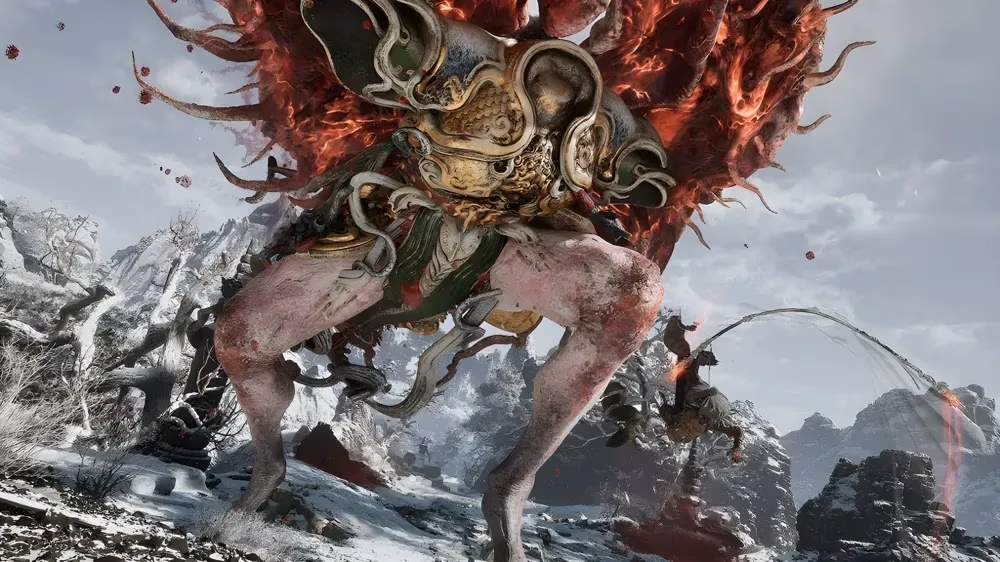
Combat Mechanics
This is where the Souls game experience can start to deviate from the traditional Souls game model. Timing your dodges are extremely important, and if you perform a perfect dodge just before your enemy lands an attack, you will activate a slow motion sequence and will also give the opportunity to perform an empowered heavy attack without needing to use your stamina. This added level of reward for successfully timing a dodge is more reminiscent of the mechanics in Sekiro than the mechanics in Dark Souls, but both have a heavy dependence on timing and commitment from the player; the feel between the two is different.
One of the most noticeable differences in the combat system between the two game types is that there is no stamina bar for attacking. You can continue attacking without worrying about using the same resource on your offense as you will need for your defense. This single change makes a huge impact on the speed of combat. Because of the intentionality of combat movements and actions in both games and the fundamental philosophy behind those actions by the player, there is a distinct representation of how each game employs a progression mechanism.
Unlike Dark Souls, which has a slow, measured pace and rhythm to combat movements and interactions, Wukong has a much more fast-paced and frenetic style of combat, driven by momentum and pressure.
The Medicine Gourd has resource management capabilities like the Estus Flask, but is much more versatile in its customization options. The vessel containing the medicine, the base drink used for Healing%, and the possible infusions added to each Gourd for Increased Focus, and/or Reduced Mana Cost are just a few examples of the greater variety of ways to customize your medicinal resources before going into fight against a difficult boss and to give players much more control of the amount of preparation put into that encounter. Therefore, this additional layer of preparation allows players to increase their chances of completing the encounter successfully, and demonstrates how the mechanics in Wukong have similarities to those of Soulslike games, but not as created or constrained by the Souls proceedings.
Another important characteristic about Wukong’s game-play mechanics is how developers used multi-phase boss designs to create the narrative/story/world-building in Wukong; as multiple gameplay mechanics exist throughout the Yaoguai bosses, and how those mechanics progress/change as a boss enters a new phase. For example: In some cases using new attack strings or changing the rhythm/timing of the attack strings may add an element of complexity/challenge to that encounter, making it necessary for you as a player to change how you execute your attacks at any given time. These examples of sequenced-phase attacks, exemplify how FromSoftware’s approach to creating their boss attractions (as well as creating immersion for the player) have also been a central element of the overall success of Wukong, in my opinion.
In addition to the fact that Souls Games typically have a traditional statistics build (e.g., Vigor = hit point, Strength = melee attack damage output, Dexterity = ranged damage output, Intelligence = ability to cast spells), one of the major factors that Wukong differs from Souls is because Wukong does not have a typical character leaf-based character creation system, which therefore has removed a player's need to choose how many points they are assigning to their characters. Wukong doesn't function in the same manner as other games do.
Instead, your progression is based on skill trees that relate to the three combat positions—Smash, Pillar and Thrust—in addition to having different upgrades for your spells and transformations. You aren't going to have an old-school RPG character sheet with trade-offs and breakpoints; instead, you'll be unlocking tools and sharpening your combat kit. It is much closer to expanding a martial arts moveset versus the traditional way of creating a character build in a Soulsborne-style game.
The combat speed in Black Myth: Wukong is also much quicker than in any of the FromSoftware main series titles. Light attack combos connect rapidly, attuning to different stances helps extend your combo and most boss fights' rhythm resembles more of a mix between Bayonetta and God of War as opposed to Elden Ring and other games in the FromSoftware catalogue. In addition to that slower and heavier gameplay style associated with Soulslike games—where your character does not move quickly; however, when they hit something, they hit hard and roll to avoid being hit—those qualities are not present in any way in Black Myth: Wukong.
In terms of level structure, Black Myth: Wukong is mostly linear in design across six total chapters that include simple to follow paths through very large but more organized spaces. A player will still find hidden areas, optional bosses to defeat and areas other than the main story that they should investigate, but it is not like the games developed by FromSoftware, such as Dark Souls, where the world is very tightly interconnected. No doubt about it, Black Moth: Wukong has very beautiful levels, including Black Wind Mountain, Flaming Mountain and Webbed Hollow, however, they are more focused on moving players toward their goals rather than allowing players to wander aimlessly throughout a large maze.
The death penalty in Black Myth: Wukong is not very intimidating. The effect that a lighter death penalty would have on the atmosphere of Black Myth: Wukong is significant. In the Dark Souls or Elden Ring, death requires you to leave behind your entire progress currency (souls or runes) with a choice to risk your entire progress in an attempt to recover. In Wukong you die, return to your last shrine, and your Will remains present at the time of your death. You do not lose any of your progression currency due to your death. Having just that single change relieves the greatest amount of stress about repeated attempts, even though the bosses are all still very challenging.
The three stance combat system is probably the most obvious indicator that Wukong has carved out its own identity. Smash Stance has heavy hitting attacks that have a good amount of stagger potential, and the ability to perform charged attacks that can completely break an enemy’s posture. Pillar Stance allows for more acrobatic movement and the use of kick based attacks while allowing you to plant your staff so you have additional forms of mobility. Thrust Stance is the quickest stance and provides the greatest amount of time for dealing pressure to your enemies and building on the application of status effects. The ability to switch between these stances during combat increases combo opportunities and tactical decisions that feel more closely aligned to an action game as opposed to a traditional Soulslike.
Through the use of the spell and transformation toolkit, this sentiment is not only apparent but is further supported by your ability to equip four spells that are all highly impactful with many of them, particularly Immobilize, capable of freezing other players for a few seconds allowing for a large amount of damage to be done while they are frozen. In addition to this, Spirit transformations allow the Destiny One to temporarily change into the appearance of enemies, complete with the ability to use their unique abilities and receive invincibility frames when activating a Spirit Transformation. As a result, you have access to much more flexibility than the typical Souls game provides.
Also very player-friendly is the option to respec your characters free of charge. Nothing comes close to the flexibility of Black Myth: Wukong as a gameplay experience. At any shrine, players can refund and reassign their skill points for free, allowing for experimentation with different stance configurations, spell selections, and transformation orders. Compared to the limited respec options available in Elden Ring, or the commitment-based leveling system in Dark Souls, Wukong offers a much more forgiving method of progression.
Comparison of Black Myth: Wukong with Dark Souls, Sekiro, and God of War
Placing Wukong alongside its most similar genre comparables, it becomes much easier to see Wukong’s identity. Comparing Wukong to Dark Souls, the most apparent distinctions between both games are: there is no stamina system; there is no penalty of losing currency upon dying; the world is not interconnected; and the combat speed in Wukong is greater than in Dark Souls. Additionally, both games have very different atmospheres. Wukong embraces a vibrant mythological adventure based on Journey to the West, while Dark Souls features themes of decay and environmental storytelling that are more subdued and ambiguous. The only similarities between Wukong and Dark Souls are their checkpoint systems and the way each game has bosses as the primary challenge in terms of progression.
In some ways, the Sekiro comparison to Wukong is even stronger than the Dark Souls comparison. Sekiro and Wukong have the same protagonist and both use a fixed combat identity system as opposed to a completely customizable avatar. Both games reward players for precise execution while punishing players for being overly aggressive. Major bosses in both games represent a major part of progression. Particularly, the perfect dodge mechanic within Wukong seems to be targeting the same level of satisfaction that Sekiro achieves through its emphasis on timing for executing at the right moment (i.e., when fighting a boss). However, with regard to mechanics that go hand-in-hand with the world, Sekiro has a posture system, a resurrection system, and a world that is highly interconnected – none of these mechanics will be reflected in Wukong.
Regarding God of War, these two games probably share the most similarities regarding gameplay and content. Both are mythological-themed, action-oriented, and have chapter-based, clear progression structures. Both places emphasis on spectacle, cinematic boss fight, and protagonist with a defined play style when it comes to combat. This has a large part in why many people referred to Wukong as a “Chinese God of War” when it released. In terms of pacing, presentation, and overall feel, this reference has a clearer translateton than calling it a straight Souls-like.
| Game | Best If | Avoid If |
|---|---|---|
| Dark Souls/Elden Ring | Heavy build stat, open exploration, methodical combat. | You dislike stamina management or death penalties. |
| Sekrio | Precision rhythm combat, tight interconnected worlds. | You prefer flexible builds and have no ranged options. |
| Black Myth:Wukong | Fluid action combat, dense variety of bosses, mythological storytelling. | You plan to explore an open world or have deep crafted builds. |
| God of War | Cinematic, narrative focused, moderate challenge. | You want to experience Souls-like difficulty. |
Will Souls Fans Like Black Myth: Wukong?
If you currently enjoy souls games, you will likely enjoy this for all it offers. The boss roster is heavily laden with an array of stunning design, and attack types give the game a continual sense of forward momentum, while the pattern learning from repeated attempts is relevant to Souls veterans.
There are two types of players likely to miss out on the fun. The first type is players who expect to have a similar experience to Dark Souls, but with different graphics. Compared to traditional Soulsborne titles (Demon's Souls, Dark Souls, Bloodborne, or Sekiro), Wukong is a faster-paced, more ability-reliant experience that places much less emphasis on punishing players financially for dying. Because stamina is not utilized in Wukong, and due to the fact that you will rely on your use of spells much more heavily than you would in a Soulsborne game, the overall gameplay style of Wukong can be considered to incorporate different aspects of mastery than what you might expect when playing other Soulslike titles. Rather than focusing on slow, conservative resource management and carefully monitoring your health when attacking/dodging; players will be rewarded more frequently for adapting quickly through aggression and utilizing smart tools.
Since the game is designed to be challenging throughout, it may be beneficial to do a quick check on how hard Wukong is (in general) before you start playing. Chapters 4 through 6 are intense due to its multiple boss encounters (both optional and required) and the sheer brutality of its mandatory, multi-phase bosses, while the overall difficulty does tend to level out across the entire game. Therefore, when playing this game, the distance between boss encounters tends to be significantly less difficult than boss encounters, which is very different from the way other Soulslike games operate (consistent pressure).
If you are starting from scratch, here are a few helpful hints:
-
Don't overlook Immobilize; it's one of the best items in Wukong, particularly in the early part of the game.
-
Upgrade your Medicine Gourd early; extra healing capacity is a huge benefit when trying to defeat bosses.
-
Use deaths as information; most deaths will teach you at least one thing you can use against the boss if you take the time to follow the patterns of each attack.
Ultimately, the best mindset when playing Wukong is to try to play Wukong as a Wukong; use the patience you have when playing other Soulslike titles only part of the time and avoid forcing the game to conform to typical Soulslike title conventions. Frequently Asked Questions
Will Black Myth: Wukong be considered the hardest game compared to Elden Ring?
Most players probably will not find Black Myth harder than Elden Ring. As always, it comes down to the individual player’s playstyle. Elden Ring has much more flexibility in that you can grind levels or play co-op with others to reduce the difficulty while Black Myth does not offer the same level of flexibility to increase your level and overcome enemy difficulty – so your grind will be limited by how much you can gain experience; however, that due to not having a death penalty and you may respawn where you are without any penalty, means you do not experience as much of a penalty for your failures as you do in Elden Ring. Some of the secret bosses and final bosses in Black Myth will be equally as challenging and potentially more than many others found throughout Elden Ring.
Is Black Myth: Wukong suitable for someone who is new to Souls-likes?
Yes – and may even be one of the most straightforward games to play if you are new to this genre of action RPG. With no penalty for dying, free to reset your skills, and many very powerful spells available to you, you will have much more opportunity to try new things and get back to where you want to be after you make a mistake. The later game still requires players to exhibit some degree of patience, recognize patterns in enemy attack patterns, and execute correctly.
Are there difficulty levels in Black Myth: Wukong?
As of October 2026, you cannot change the difficulty within Black Myth. You will not find an option within the options menu to change the challenge level of this game. However, the game does have several “soft modifiers” that you can use to reduce the difficulty in this particular game, such as; free respec, strong spellcasting options, and stat boosts that provide invincibility when activated, which will aid in making difficult challenge scenarios much easier for the player if he/she chooses to utilize these options.
What kind of genre is Black Myth: Wukong?
The most accurate genre classification for Black Myth is Action RPG with Souls-like influences. If you are looking for a short version, you can also refer to it as a game that is Souls-like adjacent to other Action RPGs with Souls-type characteristics. It has a number of Souls-like characteristics, such as boss-oriented design, healing at a checkpoint, and having a re-trial-based approach to learning how to defeat a boss. Still, it has a unique play style to it with how fast paced the combat is, having linear growth for the character, and a lot more flexibility with the systems when compared to a normal action RPG title.
Conclusion
Ultimately, is Black Myth a game in the Souls genre? No, not really a pure Sold-like game as developed by FromSoftware. However, it has many similarities and similarities between the FromSoftware Souls-like game and Black Myth; the shrines, the punishing healing, the boss-first model, and the repetition pattern to learn to defeat a boss. Additionally, the character actions being faster, the stance-based combat system, having a heavy spell toolkit, and lower death penalties make this game its own distinct type.
When you get ready to play Black Myth: Wukong, you should approach it rather than label it, focus on how best it plays. To get the best experience you need to be patient as a Souls fan will, flexible as an action fan, and prepared to learn how it works without forcing your expectations of it and be willing to put the time and investment into figuring out how the systems of the game actually work. If you do all of that you will find one of the best boss-driven action RPGs in the last several years of video gaming, good luck hunting to become an important assassin of the Destined Ones.