 BlackMythWukongZone
NVIDIA’s 2024 GDC Roadmap: What Still Matters in 2026
NVIDIA's pre-GDC 2024 briefing linked DLSS 3, ray tracing, Reflex and GeForce NOW to flagship titles, shaping 2026 PC/cloud expectations.
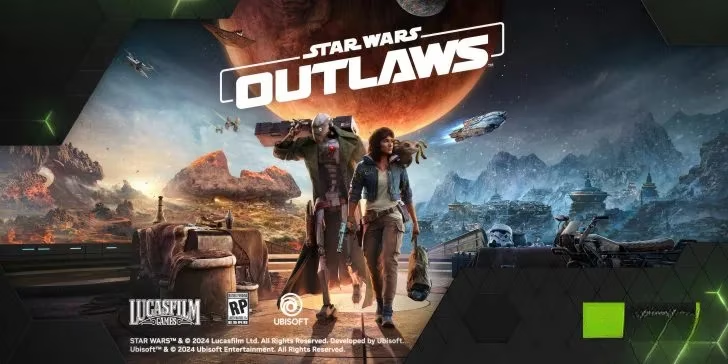
In 2026, NVIDIA’s pre-GDC 2024 briefing reads like a time capsule with a still-active battery. The company used the run-up to Game Developers Conference to attach DLSS 3, ray tracing, Reflex and cloud access to a slate of high-profile titles. The headline act was Ubisoft Massive’s Star Wars Outlaws, which was set to arrive in 2024 with DLSS 3, ray-traced effects and Reflex, and was also positioned as a GeForce NOW showcase for Ultimate subscribers. Two years later, the question is not whether the list was long. It is why this particular mix of technologies still shapes how players judge a PC release in 2026.
☁️ A Cloud-First Showcase for Star Wars Outlaws
NVIDIA made Star Wars Outlaws the centerpiece of its GeForce NOW Thursday messaging. The pitch was straightforward: Ultimate members would not merely stream a downgraded version; they would get DLSS 3, ray tracing and Reflex through the cloud. In 2024 that was a statement of intent. By 2026, it is closer to an expectation. Cloud subscribers now ask harder questions: Does the stream preserve frame generation? Is latency low enough for Reflex to matter? The old announcement anticipated those questions rather than answering them fully. Still, it marked a clear shift. Cloud gaming was no longer being sold only on convenience. It was being sold on parity with local hardware, or at least on a credible imitation of it.
That framing matters because Star Wars Outlaws was not a small indie experiment. It was a major licensed open-world title from Ubisoft Massive, and NVIDIA used it to argue that GeForce NOW Ultimate could carry flagship visual features. In 2026, that argument is familiar, but it was not routine in early 2024. The industry was still debating whether streaming could handle ray-traced effects without turning into a blurry compromise. NVIDIA’s answer was to put the feature list front and center.
🚀 Black Myth: Wukong and the Path-Tracing Push
Another long-awaited title, Black Myth: Wukong, was scheduled for August 20 and slated to support DLSS 3.5 with Ray Reconstruction and full ray tracing. The phrase full ray tracing effectively pointed toward path tracing, similar to the approach associated with Cyberpunk 2077 and Alan Wake 2. Why does that matter? Because it moved ray tracing from a selective effect to a broader rendering philosophy. By 2026, path tracing is still demanding, but it is no longer a niche benchmark curiosity. It is a marquee feature that players discuss in terms of performance cost, image stability and hardware headroom.
DLSS 3.5 Ray Reconstruction helps improve the fidelity of ray-traced effects and the responsiveness of dynamic lighting. That technical detail is easy to gloss over, but it addresses a real problem: ray tracing can look noisy or unstable without intelligent denoising. The same logic appeared in Portal with RTX, where NVIDIA added DLSS 3.5 Ray Reconstruction and RTX IO. The company said texture load times could be reduced by up to 5X, while the disk footprint of Portal with RTX dropped by 37%. Those numbers are not glamorous, but they matter. What good is a beautiful ray-traced world if the texture pipeline stutters?
🎮 NARAKA, Khazan, Diablo IV and the Ecosystem Play
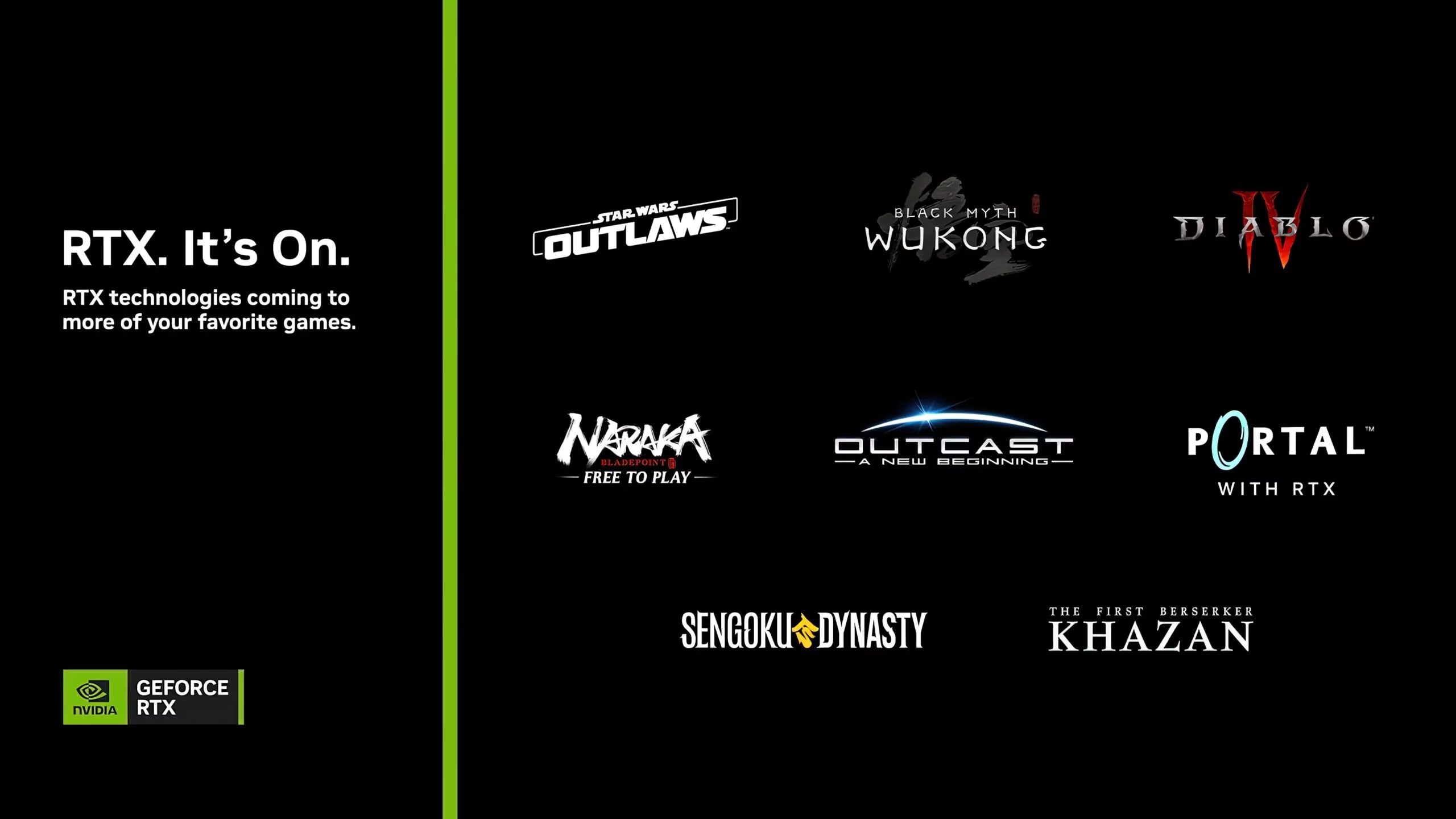
NARAKA: BLADEPOINT was set to receive full ray tracing starting with three areas accessible through both PVP and PVE modes, with further areas to follow over time. The First Berserker: Khazan, the single-player action RPG set in the Dungeon and Fighter universe, was slated to support DLSS 3 and Reflex at launch. Diablo IV’s ray tracing update received a March 26 date, adding ray-traced reflections on armor, water, windows and other reflective surfaces, plus ray-traced transparent reflections and ray-traced shadows. Sengoku Dynasty entered early access with DLSS 3, Outcast: A New Beginning arrived with DLSS 2 and DLAA, and RTX Remix Open Beta was set to receive DLSS 3.5 Ray Reconstruction.
The through-line was clear: NVIDIA was selling an ecosystem, not a single GPU feature. A game could use DLSS for performance, Reflex for latency, ray tracing for image quality and RTX IO for asset streaming. In 2026, that bundle is the baseline against which new releases are measured.
| Feature | Title | 2026 Read |
|---|---|---|
| DLSS 3, ray tracing, Reflex | Star Wars Outlaws | Cloud flagship with local-style features |
| DLSS 3.5, full ray tracing | Black Myth: Wukong | Path tracing moves into major action RPGs |
| Full ray tracing rollout | NARAKA: BLADEPOINT | Live-service upgrades arrive in stages |
| DLSS 3, Reflex | The First Berserker: Khazan | Action RPG performance baseline |
| DLSS 3.5, RTX IO | Portal with RTX | Faster texture loading, smaller install |
| Ray-traced reflections and shadows | Diablo IV | Visual fidelity across reflective surfaces |
📊 The GeForce NOW Weekly List
NVIDIA also shared its weekly GeForce NOW additions, which underlined how broadly the cloud catalog was expanding beyond flagship showcases.
| Game | Note |
|---|---|
| Hellbreach: Vegas | New release on Steam, March 11 |
| Deus Ex: Mankind Divided | New release on Epic Games Store, free March 14 |
| Outcast - A New Beginning | New release on Steam, March 15 |
| Balatro | Steam |
| PARANORMASIGHT: The Seven Mysteries of Honjo | Steam |
| Space Engineers | Xbox, available on PC Game Pass |
| STAR OCEAN THE SECOND STORY R | Steam |
| STAR OCEAN THE SECOND STORY R - DEMO | Steam |
| Warhammer 40,000: Boltgun | Xbox |
🔍 The 2026 Verdict
The 2024 briefing did not just announce features; it set a vocabulary. In 2026, players expect DLSS, Reflex, ray tracing and cloud parity to be discussed together. Was the industry better for it? Mostly yes, though the cost is that full ray tracing can mean very different things from one game to another. The lesson from NVIDIA’s GDC 2024 slate is that technical marketing ages quickly, but the questions it raises about performance, image quality and access do not. The cloud push around Star Wars Outlaws, the path-tracing ambition of Black Myth: Wukong, and the incremental upgrades to Diablo IV and Portal with RTX all point to the same 2026 reality: the feature list is now the starting line, not the finish.
Industry analysis is available through Game Informer, whose long-running reporting helps frame why NVIDIA’s 2024 GDC lineup still feels relevant in 2026: players now judge releases like Star Wars Outlaws, Black Myth: Wukong, and Diablo IV not just by art direction or scale, but by how well DLSS, ray tracing, Reflex, and streaming support combine into a polished PC experience.